
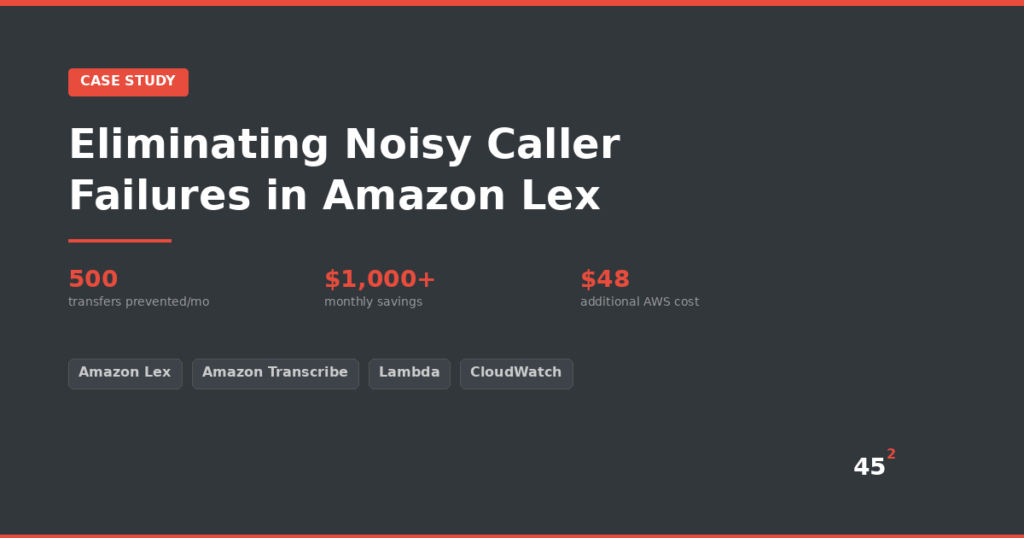
Case Study
Eliminating Noisy Caller Failures in an Amazon Lex Contact Center
How we helped a client cut 500 unnecessary agent transfers per month by rearchitecting their Amazon Lex voice bot for noisy real-world environments.
500
Transfers Prevented / Month
$1,000+
Monthly Savings
$48
Additional AWS Cost
The Client
A contact center operations team running Amazon Lex as the front line of their customer-facing voice bot. The bot handled thousands of calls per month — routing inquiries, collecting account information, and resolving common requests without human agents.
The Challenge
The bot worked great in testing. In production, it fell apart. Callers were phoning in from cars, construction sites, busy restaurants, and airports. Background noise was destroying the speech-to-text accuracy, which meant Lex couldn’t match the right intent. Callers got stuck in retry loops, gave up, or got dumped to a live agent — exactly the outcome the bot was built to prevent.
The client estimated that roughly 5% of all calls were being unnecessarily transferred to human agents due to noisy transcriptions. At 10,000 calls per month, that’s 500 avoidable transfers — each one costing agent time, increasing wait queues, and frustrating customers.
What We Built
We decoupled the speech-to-text layer from Lex’s built-in processing and replaced it with Amazon Transcribe, which is purpose-built for telephony audio and significantly more resilient to background noise.
Before
Audio → Lex (STT + NLU)
↓
Garbled transcription
↓
Wrong intent matched
↓
Agent transfer
After
Audio → Transcribe (STT)
↓
Clean text
↓
Lex RecognizeText (NLU only)
↓
Correct intent ✓
🔊
Amazon Transcribe
Noise-resilient STT
🤖
Amazon Lex V2
Intent & dialog
⚡
AWS Lambda
Orchestration
📊
CloudWatch
Monitoring
The Result
Intent accuracy improved significantly across noisy call environments. The new architecture prevented approximately 500 unnecessary agent transfers per month, saving over $1,000 in wasted agent time — far exceeding the ~$48 in additional AWS service costs.
The added latency of 100–400ms per utterance was imperceptible to callers. The client’s contact center team now has clear dashboards showing transcription quality and bot success rates, and a Lex deployment that works as well on a construction site as it does in a quiet office.